If the war in Ukraine ends, what happens to your royalty check?
Four years of war rewired the gas trade and gave West Virginia owners their best royalty year in a decade. If the war ends, prices most likely fall, and the European pledges that would cushion the drop depend on politics that can change.
9 min readReviewer: To be confirmed before launchDraft until a named reviewer signs it
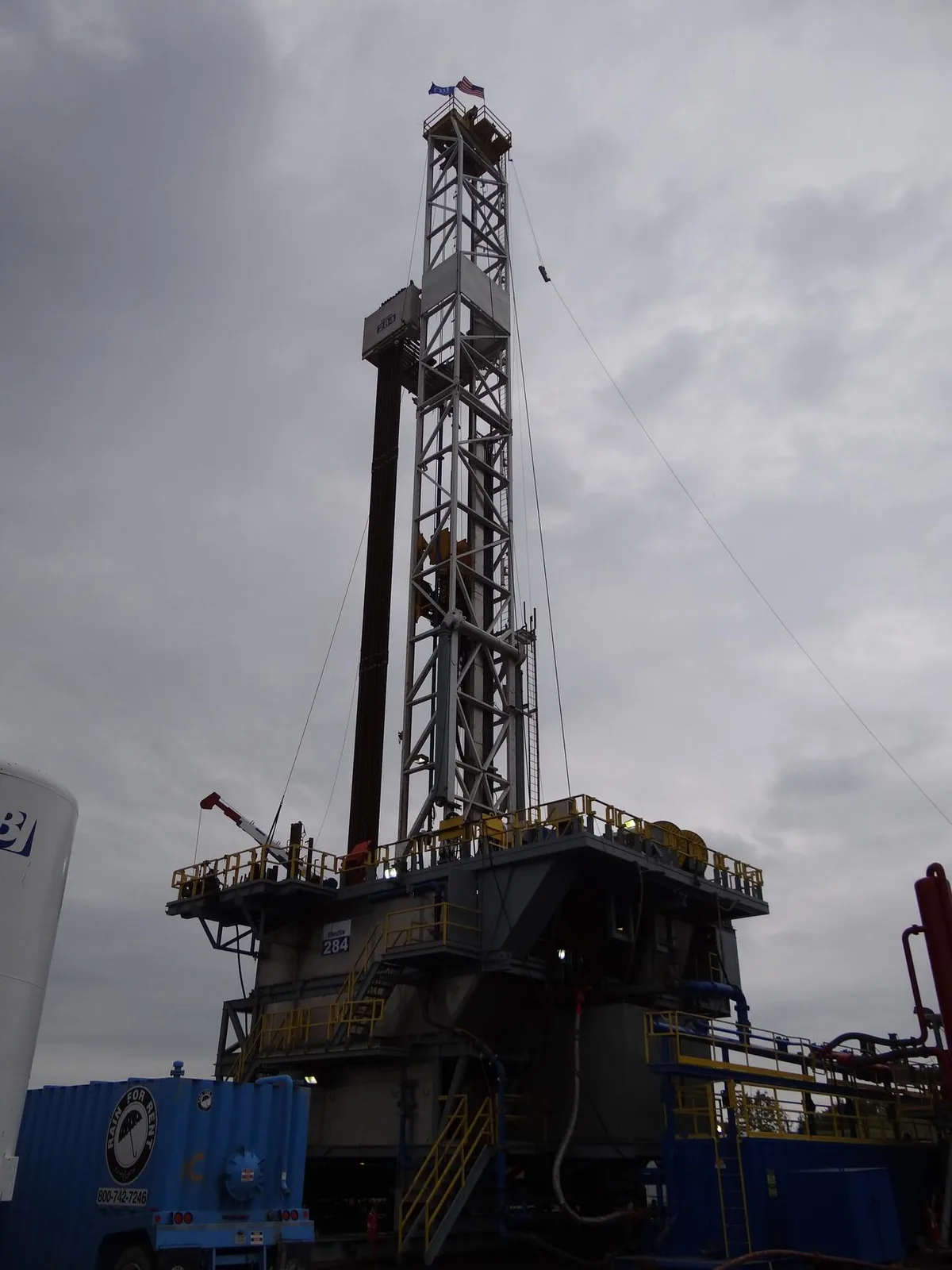
A Marcellus shale drilling rig in southwestern Pennsylvania. Photo: Ken Skipper / USGS.
The short version
The war lifted West Virginia royalties once, in 2022Europe lost most of its Russian pipeline gas and bought liquefied natural gas instead, much of it American. U.S. export plants ran flat out, and Henry Hub averaged $6.42 for the year, the highest in a decade. Owners saw it on their statements.
The lift did not last, and the war was still onBy 2024 Henry Hub averaged $2.19, the lowest year in the series after inflation. Mild winters, record production, and a pause in new export capacity did that. The war premium was one force among several, and not the biggest for long.
If the war ends, prices most likely go downThat is our view, and the direction is the easy part. Less fear in the oil market and the prospect of Russian gas finding a path back both push prices down. Exporters’ margins go first, then producers’ profits, then the spot price, then your statement, with a lag. Mineral offers fall before statements do, because buyers price the forward curve.
Europe’s pledges are a cushion, not a guaranteeThe European Union has committed to ending Russian gas imports by 2027, which is why many expect the trade not to snap back. But pledges are made by governments, and governments change. New leadership in a large member state, a hard winter of high bills, or an industrial slump could reopen the question. Count on the pipelines and export plants, which are physical; count less on the promises.
What the war did to the price
Monthly averages of the EIA daily spot series through 2026-10-19. The 2022 peak is the war; the 2024 trough is weather, record production, and a pause in export growth; the January 2026 spike is a storm. Daily prices went higher than any monthly average shown: $9.85 on August 22, 2022 and $30.72 on January 23, 2026.
Russia invaded Ukraine on February 24, 2022. Before that, Russian pipelines supplied roughly two fifths of the gas the European Union imported. Within months most of that supply was gone, through sanctions, through Moscow’s own cuts, and in September 2022 through the sabotage of the Nord Stream pipelines under the Baltic. Europe replaced what it could with liquefied natural gas delivered by ship, and paid whatever it took. The United States, which had become a large LNG exporter only a few years earlier, sent every cargo its plants could load.
That demand reached Henry Hub, the benchmark behind West Virginia gas, through the export terminals on the Gulf Coast. The monthly average went from $4.38 in January 2022 to $8.81 in August, and the daily price touched $9.85 on August 22, the highest since 2008. It would have gone higher: a fire at the Freeport LNG plant in Texas in June took about two billion cubic feet a day of export demand out of the market for months. Oil had its own spike, with WTI at $123.64 on March 8, 2022, before sanctions, price caps, and rerouted Russian barrels settled it back.
On a West Virginia royalty statement, 2022 was the strongest year in more than a decade. Statements for 2023 production were often less than half of the 2022 statements for the same wells, and the difference was price, not volume. Offers to buy minerals rose with the price in 2022 and fell with it afterward, which is worth remembering when an offer made then is compared with one made now.
Why the war premium faded while the war went on
Nothing about the war changed in 2023, and Henry Hub averaged $2.54. The winter of 2022 to 2023 was mild, U.S. producers set production records, storage refilled quickly, and the daily price fell to $1.74 in June 2023. The year 2024 was worse: a warm winter, storage far above normal, production still near records, and a pause in export growth while the next wave of plants was being built. Several Appalachian producers shut in wells in the spring of 2024 to wait for better prices, and the annual average of $2.19 was the lowest in the series after inflation.
The lesson is the one this site repeats on its prices page. American gas follows weather, storage, production, and export capacity. A war in Europe moves one of those four, export demand, and only as far as the export plants can carry it. Once the plants were full, Europe’s desperation could not raise Henry Hub further, and once American drillers responded to the 2022 price with record output, the premium drained away even though the war did not end.
Prices recovered in 2025, to an average of $3.53, as a colder winter met new export capacity at Plaquemines and Corpus Christi. Then a storm in January 2026 printed $30.72 on a single day and a $7.72 monthly average, and February was back near $3.60. In 2026 oil had a war of its own, with the Strait of Hormuz closed and WTI above $100 for much of the spring and summer, while gas stayed near $3. The two commodities answer to different wars.
What a settlement could change
The fear premium in oilMarkets price the risk of the next disruption. A settlement lowers that risk, and oil tends to fall before any barrel actually moves. In 2026 the Iran war matters more to oil than Ukraine does, so the effect on WTI may be modest and quickly swamped.
Russian gas finding a path back, pledges or notOn paper the European Union ends Russian gas imports by the end of 2027, pipeline and LNG alike; the Ukraine transit route closed on January 1, 2025, and Nord Stream is damaged. A settlement would not undo the damage. But the pledge is a political decision, and politics in Europe are not settled: a change of leadership in Berlin, Paris, Rome, or Brussels, or a single winter of unaffordable bills, could revisit it, exemption by exemption. If even part of the old flow returns, a market that has been short since 2022 gets longer, and prices fall further than the oil premium alone would take them.
Narrower margins on American LNGU.S. exporters earn the gap between Henry Hub and the European or Asian price. If Europe pays less, that gap narrows, the newest plants earn less, and the pull on Henry Hub weakens. The exporters feel it first; the price at the wellhead feels it later.
Producers’ profits, then their drillingAppalachian producers hedge a share of their output a year or two ahead, so a price drop reaches their profits with a lag and reaches their rig count after that. In 2024 the response to low prices was to shut in wells, which cut royalties by volume as well as price.
Your statement, one to two months laterMost West Virginia gas sells on monthly index prices, so a lower Henry Hub shows up on a statement a month or two after the production month, minus the Appalachian discount and whatever deductions the lease allows.
Mineral offers, before your statementA buyer prices the forward curve, not last month’s check. If a settlement pulls the curve down, offers fall first, including ours. An offer made during a war premium and one made after it are not the same offer.
What would not change
The wells and their declineA producing well keeps producing. Shale wells decline steeply in their early years whatever the price, so a statement that is shrinking may be the curve, not the market.
Your fractionA share of the minerals is a share of whatever they earn. The war changed what they earn; it changed nothing about who owns them.
The export plants and the pipelinesU.S. LNG capacity roughly doubled between 2022 and 2026 and more is under construction. The Mountain Valley Pipeline, in service since June 2024, narrowed the Appalachian discount. That infrastructure stays whatever Europe decides, and it keeps Appalachian gas connected to the world price. It is the part of the 2022 change that depends on no one’s pledge.
Demand that has nothing to do with EuropeUtilities’ plans for gas-fired power to serve data centers were the growth story of 2025. If they hold, they support demand whatever happens in Ukraine. If they fade, that is a separate risk.
What an owner can do with this
Do not compare today with 2022A 2022 statement or a 2022 offer is the high-water mark of a war. The honest comparison for a producing well is its own decline curve at today’s forward price.
Watch the forward curve, not the headlineBuyers and lenders price the strip a year or more ahead. The prices page shows the spot history; the curve is what an offer is built on, and the offer says which curve it used.
Keep every statementVolumes, prices, and deductions by month are the record of what your interest earned through the war. The royalty check guide explains each line.
If you are weighing a sale, know what the buyer is assumingA written offer should state the forward prices and the decline it assumes. Ours does. If a settlement is in the news, ask any buyer what their offer assumes about it. The sale walk-through lists the questions.
Questions owners ask
Is this a forecast?
It states a view: if the war ends, prices most likely fall. It does not say how far or when, because nobody can. The prices in it are the EIA record, cited; the direction is our judgment, and the piece says so wherever it leans on one. We are a buyer, and a lower price is also a lower offer from us.
Could Europe go back to Russian gas?
Officially no: the European Union has committed to ending Russian gas imports by the end of 2027. In practice that pledge was made by one set of governments and can be revisited by the next, and Europe’s politics are not settled. The signs to watch are an easing of sanctions on Russian LNG, a member state asking for an exemption, or talk of reopening a pipeline. Any of them would push gas prices lower than a settlement alone.
Why would European peace move an American price?
Through the export terminals. The United States became the world’s largest LNG exporter in 2023, and every cargo that leaves the Gulf Coast is gas that did not stay in the domestic market. When Europe pays more, exporters load more, and Henry Hub rises. When Europe needs less, the chain runs in reverse.
Has anything like this happened before?
Prices fell by more than three quarters between August 2022 and June 2023 with the war still going, because weather and production overwhelmed the export pull. That is the closest precedent for what a settlement in a soft market could look like.
What about the Iran war and oil?
In 2026 the closure of the Strait of Hormuz has mattered far more to oil than Ukraine has, and far less to gas. An owner with oil or condensate royalties should read the 2026 period on the prices page; a Ukraine settlement is a second-order event for that market right now.
Should I sell before a settlement?
That is a decision only you can make, and this site is published by a buyer, so weigh our view accordingly. The useful facts are these: offers already reflect the forward curve, a curve can fall before any settlement is signed, and an owner who keeps a producing interest keeps whatever it earns through the next cycle. The free screening tells you what you own; the sale walk-through tells you what an offer must state.